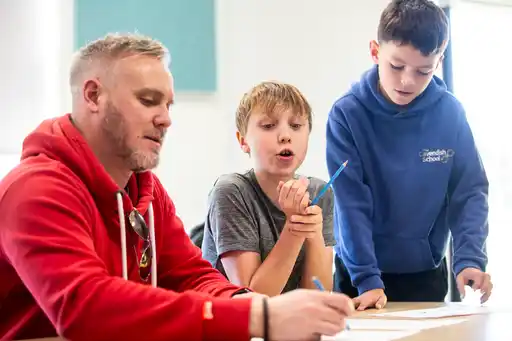
Official government data shows that there are more than 166,000 autistic students in schools across England – 70% of whom are in mainstream schools. The rest are in specialist provision, home-schooled or are out of education completely.
Mainstream education can present multiple barriers to education for students with autism such as:
- understanding the hidden learning embedded in the National Curriculum;
- creating connections between their learning in different subjects;
- the need to develop their cognitive comprehension.
For four years now, we have taught the UK National Curriculum using the International Baccalaureate (IB) Primary Years Programme (PYP) framework. The approach offers a continuous learning journey while being flexible in meeting the needs of autistic students by teaching them skills for life, rather than finite facts.
Alongside academic knowledge, the IB focuses on the development of the whole student, and an essential element of this holistic programme is the IB learner profile: ten core characteristics that are essential for intellectual, personal and social growth, regardless of neurodiverse or neuro-typical development.
Attributes such as caring, and practical qualities like communication, are embedded within the framework to explicitly focus on preparing students for independent living, helping them to develop the ability to solve problems, make decisions and work as part of a team.
A tool to help autistic students achieve their potential
- Implicit learning becomes explicit
Implicit learning within the National Curriculum, often known as the ‘hidden curriculum’, is a consistent challenge for students with autism as they struggle to develop life skills that are not actively taught in a school, such as societal cues and values and beliefs conveyed in a social environment. As a result, autistic students need to be taught to generalise between subjects and how to apply what they are learning to real-world situations.
The PYP uses transdisciplinary themes to organise learning and teaching around the construction of meaning in real-world situations, dissolving the boundaries between traditional disciplines and giving students the tools to take meaningful action in the wider world as a result of their learning.
- Learning is tailored to students’ strengths and interests
A common trait of autistic young people is their intense focus on a small number of core interests that consume their attention, sometimes to the detriment of their engagement with their learning.
The flexibility of IB programmes enables our teachers to connect students’ interests with the subject material to create an irresistible invitation to learn. For example, Thomas the Tank Engine is a powerful gateway to exploring broad topics that remain engaging and accessible to autistic students because of their affinity for the series.
Every character in the world of Thomas the Tank Engine has defined responsibilities and there is a clear hierarchy that demonstrates the success of the community when each individual performs their role.
Creating connections between the important roles of each engine, their strengths and their weaknesses, facilitates understanding of a collective and an individual’s impact on a community because students realise the value that they add to society by being their authentic selves.
Harold the Helicopter is often perceived as noisy but he is always welcome – this observation contributes to a broader conversation about embracing your individuality and being welcomed within your community.
- Connections are created
Because, students with autism struggle to generalise their learning between subjects, an interdisciplinary approach allows students to make connections between subjects and to develop appropriate transferable skills, such as communication, research and independence, to support their successful progression towards their own education and adulthood goals.
Using thematic learning, the PYP, in particular, provides a framework for learners to use a line of inquiry as the vehicle for learning to create connections between a theme, a core subject and its relevant applications outside of the classroom.
By inverting the traditional linear method of education, IB students begin their learning with a generalised line of inquiry that facilitates a deeper understanding of the correlation between concept and context because the generalisation is explicit.
For instance, our students have explored the hypothesis that ‘a person’s identity changes throughout their life’ by following the character development of Neville Longbottom in Harry Potter.
Neville lacks confidence in himself but the belief of his friends and teachers helps him develop his confidence and thrive after the battle of Hogwarts. This enables students to create connections between their own experiences and learning.
Our parent feedback highlights the positive impact of explicit learning and student-led, skills-focused education. Our students are more comfortable with queuing, time-keeping and sharing.
Relationships are being built, which is hugely encouraging for the children who have transitioned from homeschooling to our school, and is evidence that our students are improving their social-cognitive skills to understand their own, and others’, desires, beliefs and emotions.
*Find out more at https://thecavendishschool.org.uk/