Bridget Phillipson’s call for an international SEND Alliance makes perfect sense. Countries differ, but the problems are familiar across borders.
How do you notice needs earlier, reduce paperwork and make support reach the classroom?
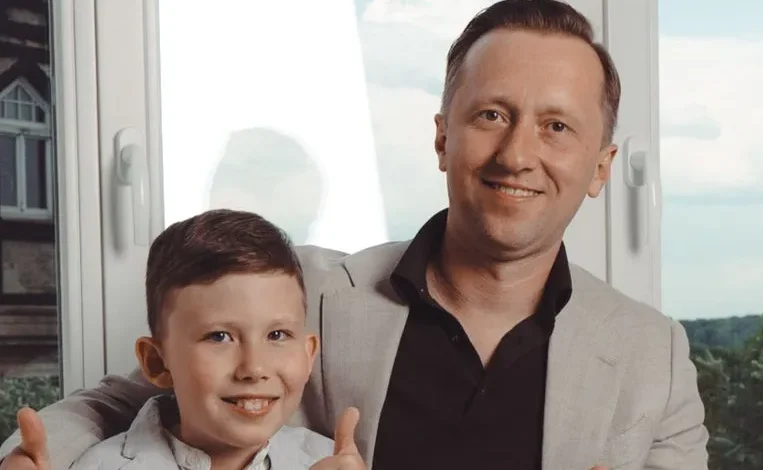
My son Kirill (pictured with me) is 12. He is on the autism spectrum and studies in a mainstream school with a tutor.
After the war with Russia forced our family to move from Ukraine to Portugal, we saw how different education systems can be for a child who needs support.
Ten years ago, when we first understood Kirill’s needs, I was already working in education. But I could not find materials I could use with him straight away.
So, I made them myself at night: printing, laminating, cutting plastic, choosing tasks and building small programmes. Kirill was non-verbal for a long period, so we used the Picture Exchange Communication System.
MIKKO is the inclusive education system that grew from that work: physical classroom kits, a six-domain developmental assessment method and AI-assisted support-planning tools for teachers, specialists and families. It began there, before it became a company.
As a father, I had to learn acceptance and turn it into practical support.
A parent’s perspective
For me, that meant asking the same question many times: what does Kirill need next, and who can help him do it?
Between 2021 and 2024, my company, UNOWA worked on a national inclusive-education model in Kazakhstan as part of the World Bank’s Education Modernization Project No. 8709-KZ, with the Ministry of Science and Higher Education.
A diagnosis can explain part of the picture. A teacher still needs the next step
The collaboration began through an open World Bank tender. UNOWA competed with international and local companies, including bidders from Italy and Bulgaria, and won the contract through the formal process.
After the pilot, the model was accepted at state level and used to inform Kazakhstan’s wider work on inclusive education and support for children with special educational needs.
Prior to this, many children with special educational needs studied at home, in boarding settings or away from mainstream schools. Even in bigger cities, schools often lacked specialists and practical readiness.
Kazakhstan’s education system meant the work had to reach several age groups. Children enter first grade at six, then move through primary, basic secondary and senior secondary stages.
The model had to serve preschool, school, vocational education and pedagogical universities training the next generation of teachers.
Preparation
The first part was shared assessment and planning. UNOWA used its six domains of development method – academic, sensory, social, speech, daily-living and physical development – for children aged one to eight.
It can be used with neurotypical and neurodivergent children, and its main value is finding strengths and weaker areas.
The results are then turned into priority goals.
A diagnosis can explain part of the picture. A teacher still needs the next step. If a child needs to develop a pointing gesture, ask for help, answer yes or no, follow instructions or manage a transition, the plan should say how to teach that skill.
In our model, the individual development plan includes goals, instructions, prompts, practice settings and the adults involved. Testing can be done by a teacher, assistant or psychologist after training. In our practice, it takes one to two days, with the programme generated in about 15 minutes.
The second part was training. UNOWA trained 70 university lecturers and specialists selected by region, so each region could support inclusive education reform locally.
The programme used 26 experts from Canada, the US, Kazakhstan, Ukraine, Poland and Serbia. Across the expert team, there were more than 100,000 hours of practical work with children with SEND.
The third part was classroom infrastructure. We equipped 14 inclusion classrooms in pedagogical universities. That placement was deliberate.
If future teachers learn inclusion only from theory, the first test comes when they meet a child with needs in a busy classroom. The rooms were built as centres of practice, where students, teachers, psychologists and assistants could work with the materials they would later use with children.
In one city, Pavlodar, for example, the university room became more than a training space. Children came there for support sessions, while the university, schools and kindergartens worked around the same centre of competence. Training and practice happened in the same place.
Across the 14 rooms, the project delivered 307 lesson kits, 1,830 teaching aids and 39 localised sets with more than 20,000 units. Each rooms had four main zones: one-to-one work, group work, classroom simulation, and sensory or physical regulation.
Progress around a child is a team effort
A child could practise raising a hand or answering questions before using the skill in class. Materials included visual toilet-training sequences, timers, social stories, matching objects, speech-development sets, mathematics sets, weighted blankets, noise-reducing headphones, sensory-integration equipment and observation kits.
The main achievement was the connection between the parts: assessment, teacher training, classroom design, localised materials and support planning.
Buying equipment is easy compared with preparing adults to know why they are using it and when to use it.
Work in progress
Kazakhstan is still building its SEND system, and I am careful about claiming more than the data supports. More than 1,500 children have gone through our system.
A Kazakhstan pilot of the six-domain screening model involved 131 children aged 18 to 72 months. In our comparison, initial screening moved from 7-14 days to under a day, individual plan development from up to six months to 5-15 minutes, and intervention from months to days.
That progress belongs to public authorities, universities, schools, specialists and families. Our role was to help connect the child, the classroom and the adults around that child. The model supports children, future specialists, teachers and parents at the same time.
That is why the UK conversation interests me.
Other countries do not need to copy Kazakhstan, but a useful question is what has to be in place when inclusion funding reaches a classroom: trained adults, clear assessment, usable rooms, family understanding and technology that turns assessment into a next step.
Kirill and Kazakhstan taught me the same lesson: progress around a child is a team effort. Knowledge, practice, specialists, materials, rooms and family support have to follow the child’s goals.
When training says one thing, materials suggest another and the team works separately, the child receives separate pieces of support.
When these parts are joined around the child, adults know what to do, parents understand why it matters, and the child has a better chance to learn.