One of the true joys of working in a primary class is that there exists a rich and complex spectrum of learner needs.
Whilst this can be challenging at times, it is also one of the most rewarding parts of the job when you can see all the children thriving.
Many children present with neurodivergent profiles—whether formally identified or not—while others may experience challenges with attention, sensory processing, communication or self-regulation at different points in their learning journey.
Over the past few years, I have been exploring ways of making my primary classroom more neurodivergent-friendly.
Most impactful changes come from rethinking how existing resources are used, rather than purchasing new ones
Crucially, this has not been about targeting specific groups but about creating an enabling environment that supports all learners to engage, participate and succeed. In doing so, I have found that approaches designed to reduce barriers for some often improve learning conditions for everyone.
Here are a few ways in which I have sought to ensure that our learning environment enables effective conditions for all children in my class.
Flexible Seating
Over several years, I have been able to increasingly vary the workspaces available in our classroom. These include:
- The Cwtch (a well-known Welsh term for a ‘hug’)
This space comprises a low-slung canopy under which children can sit on an array of cushions, selecting their preferred colour of diffused lighting through wall-mounted push lights. It creates a more enclosed, low-stimulation environment, helping to reduce ambient noise and visual distraction, for learners who benefit from a calmer sensory experience or who need support with focus and regulation.
- The Standing Station
A high-level table allows children to stand comfortably while working. This has proven to be one of the most popular spaces in the classroom. The ability to shift weight, move subtly and maintain physical engagement appears to support thinking, particularly during the early stages of independent tasks when ideas are being organised or refined.
- Carpet Surfer Seats
These ‘s’-shaped plastic seats are designed for use on the carpet, providing both a seat and a raised working surface. They have significantly increased the usability of floor spaces, allowing children to adopt comfortable and stable working positions. They are particularly effective during collaborative tasks, offering a defined personal workspace within a shared environment, while supporting those who benefit from additional physical stability.
- Bean Bag Corner
This area offers a more secluded working space using a structured, high-backed bean bag, positioned close to the teacher’s base. It is frequently used by learners who require a balance of independence and reassurance, enabling them to maintain focus while remaining within easy reach of adult support for informal check-ins or guidance.
Lighting
As with most school settings, our classroom is fitted with overhead, cold-white LED lighting. However, when combined with light-coloured surfaces, this can create an overly harsh visual environment.
Learner feedback reinforced this, with several children commenting on how ‘bright’ the room felt, so I explored some adjustments:
- Dimming Overhead Lighting
By reducing the intensity of the main lights (where possible), the overall atmosphere becomes noticeably calmer and less visually overwhelming. This simple adjustment has become part of our daily routine.
- Adjustable, Colour-Changing Lights
Rechargeable, colour-changing lights—both wall-mounted and tabletop—allow children to select lighting that suits their preferences within different working areas. Softer tones such as warm yellow, orange and purple are frequently chosen, suggesting a general preference for less intense lighting conditions.
- Uplighters
These provide diffused lighting, reducing harsh shadows across workspaces. They also help to define different zones within the classroom, supporting learners in navigating and selecting environments that best meet their needs.
- Maximising Natural Light
Where possible, I ensure that blinds and curtains are fully opened to allow natural light to fill the space. Even in environments where natural light is limited, prioritising its use has a noticeable impact on the feel of the classroom.
Fidgets
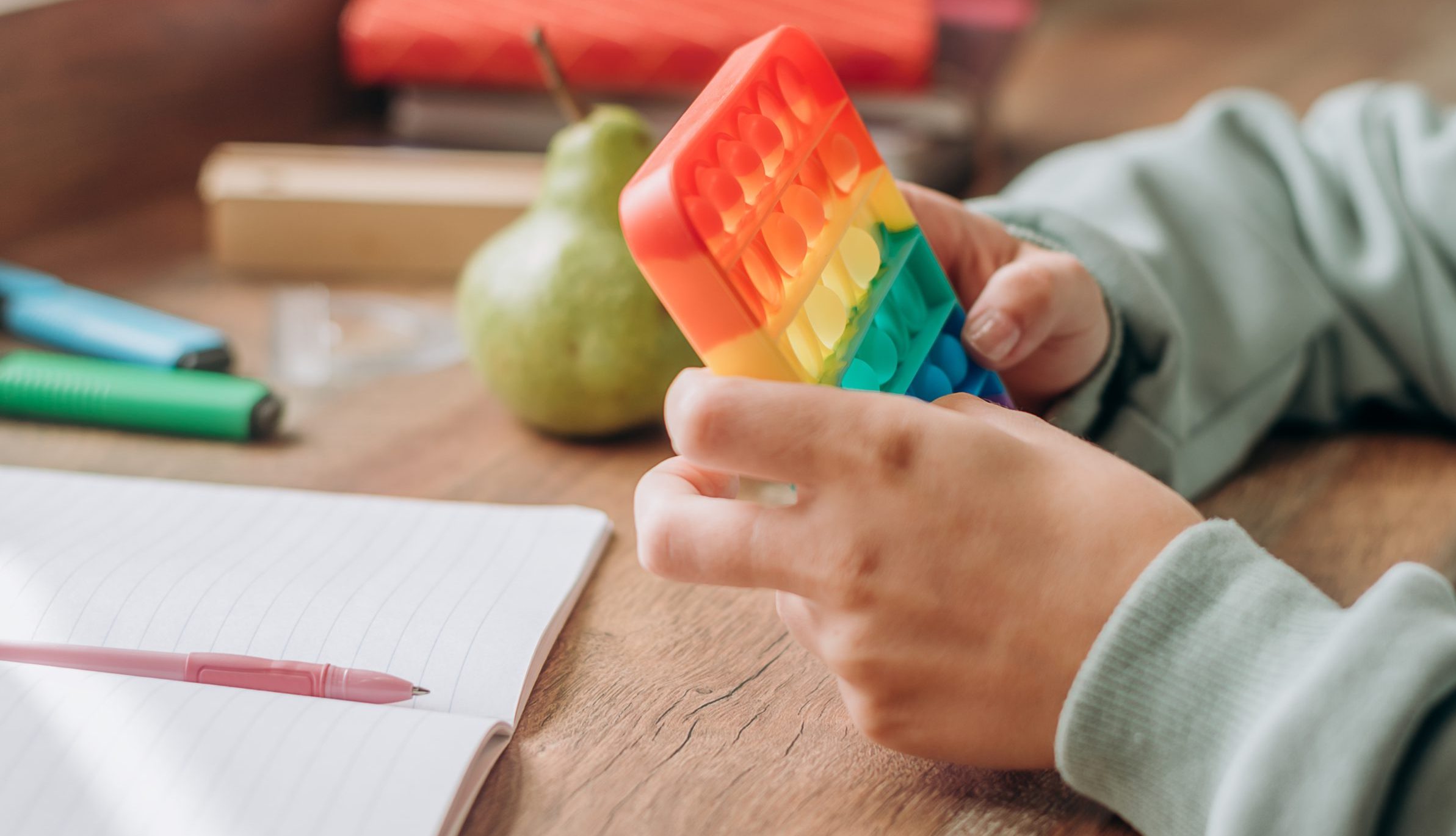
The use of hand-held fidget tools can be contentious, and without clear structures they can quickly become a distraction.
However, when used purposefully, they can support concentration, self-regulation and sustained engagement for a wide range of learners.
In our classroom, fidgets are available to all children via a shared resource jar. We establish clear expectations through open discussion at the start of term:
- If you choose to use a fidget, your focus must remain on the learning
- If the fidget becomes a distraction, it is returned immediately
Careful selection of resources has been key. We avoid items that are overly complex, noisy or toy-like. The most effective tools have been simple, tactile objects such as rubber hand stretchers, threaded nuts and bolts, and silent button or wheel fidgets.
These provide sensory input without drawing attention, allowing learners to regulate their focus in a subtle and unobtrusive way.
Implementation
One of the most reassuring aspects of developing an enabling environment is that it does not require significant financial investment.
In many cases, the most impactful changes have come from rethinking how existing resources are used, rather than purchasing new ones.
For example, flexible seating can be created by simply repurposing cushions, unused mats or even allowing children to safely access floor spaces that may previously have been under-utilised.
The ‘Cwtch’ itself is just a thoughtful use of fabric, soft furnishings and a willingness to reimagine a corner of the classroom. Similarly, standing stations can be improvised using existing furniture, while carpet surfer-style working can be replicated through clipboards or low-cost alternatives.
These adjustments are rooted more in mindset than in budget, which is especially important during the current climate of reducing school budgets when many teachers resort to personally funding their own classrooms.
Designing for inclusion is about refining the environment so it works more effectively for everyone
The same principle applies to lighting and fidgets. Before introducing any new resources it is worth exploring what is already within your control—adjusting blinds, dimming lights is possible, or simply reducing reliance on harsh overhead lighting can make an immediate difference.
Low-cost rechargeable lights are now widely available but even without them, thoughtful positioning within the classroom can help to create more comfortable working zones.
Fidgets do not need to be specialist items; simple, everyday objects such as elastic bands, small rubber balls or platted fabric strips can serve the same purpose when used with clear expectations.
In short, it is important to recognise that inclusive practice is not dependent on high-cost solutions but on deliberate, reflective choices about how we shape the environments in which our children learn.
Refining the environment
What has become increasingly clear through this work is that designing for inclusion is not about adding layers of provision, but about refining the environment so that it works more effectively for everyone.
By reducing sensory barriers, increasing flexibility and offering greater autonomy, we create conditions in which all learners—regardless of need—are better able to engage, think and thrive.
In many respects, these approaches align closely with the principles of universal design for learning: anticipating variability, rather than reacting to it.
When we do this well, we move closer to classrooms that are not only inclusive in intent, but inclusive by design.
*A version of this article was published in the Summer issue of SENDsational Futures magazine.